I have been meaning to talk about this topic for quite some time… and yet, it’s really not all that long a span of time in the grand scheme of things. That just makes it all the more important and astonishing, though!
There are very few topics in the gaming world I can discuss at length without stretching at least somewhere back in my long history with the medium for reference. Being able to discuss my experience with a series in entirety from only the last two years and change? That’s a rare gift.
So, after months of mulling it over, let’s talk about the Yakuza series.
I hadn’t originally planned to go too intently over every game I’d played — and indeed, there’s still quite a lot more I could write about each — but instead just give a rough write-up of how I got into the series and what hooked me. But once I started writing it up, the words just kept on coming until I’d gone through the entire series. It’s certainly not in-depth and the coverage of each varies, but there’s a lot here to talk about.
As such, the final word count on this behemoth of a piece is the longest I’ve written for any blog post or published article but a considerable margin. I’ve broken the text up with images, gifs, and video clips to hopefully give you some breathing room. So buckle up, and come with me on a whirlwind tour of the streets of Tokyo.

Planning A Kamurocho Vacation
In August of 2017, I purchased a copy of Yakuza Kiwami, the remake of the first game. This is the first chance I’d had to pick up and play a Yakuza game, but my story doesn’t exactly begin there just yet. Why did I purchase that game, after all?
In truth, I knew practically nothing about the Yakuza series going into it. Sure, there were probably references to it, glances at the titles on store shelves, or some kind of subconscious understanding of the series existing. That said, I had never really given any serious thought into the games and what they were, or had a chat with anyone who had played enough to fill me in. I was going in largely blind, and that lack of knowledge is actually what drew me to it in the first place.
See, I distinctly remember reading a gaming website (I believe it was Eurogamer, for context) and glancing at an article that featured newly revealed details on Yakuza 6. Something about this stuck out to me, because I remember thinking “there’s a big news article about a 6th game here, and yet I know nothing about the series”. That lack of knowledge stood out to me, and my curiosity lead me to glancing at the article.
I understood nothing, of course, but what I did understand was a link to their Yakuza 0 review. So I clicked on that, and came away very curious about what was being described. I wanted to know more, but at the time I didn’t act on it.
This knowledge eventually bore fruit when I saw an article about the upcoming release of Yakuza Kiwami. Taking the same engine from Yakuza 0, it aimed to be a full reconstruction and remake of the original game, retaining all the same story and cutscenes but modernising the combat and graphical fidelity. There we go: that’s my starting point into this mythical series of which I knew nothing. Course laid in, calendar date set, Yakuza Kiwami purchased in August 2017 when it showed up on my local store shelves. At last, I would get to play Yakuza!
I played for three hours and then put it down for four months.
…Anticlimactic, no?
These three hours were, despite their brevity, quite fascinating to me. The remake is — barring a few Majima related details — completely faithful to the original story, just delivered in more modern graphics. The same pacing, presentation in cutscenes, and style in writing and cinematography remained from the PS2 title. The combat is a hefty 3D brawler/beat-em-up with lots of big “Heat” finishing moves that range from hefty, utterly devastating, or hysterical in their antics. There’s a slew of RPG systems under the hood as well, making it more like an action/brawler/RPG than anything else.
During what little of the story I saw, there was a string of pointedly long but immensely detailed cutscenes showing the interactions of leading character Kiryu Kazuma and his friends/associates. Ultimately, he willingly takes the fall for a murder committed by his best friend Nishikiyama, and ends up serving 10 years of jail time. When he emerges… well, the city has changed, people are missing, and he’s being attacked by those who should’ve been his allies.
All of this is rendered by a mix of the aforementioned cutscenes, dialogues, or just interactions out in the world. But every time it’s presented, there’s a certain… cinematic flair to it. I mention that Yakuza Kiwami retains the cinematography of the PS2 titles, because this is something that is true of the whole Yakuza series. They are written and presented like intense crime dramas, with all the thrills, twists, conspiracies and melodrama that such media would encapsulate. It’s the kind of thing that might turn people off due to slow starts and lengthy cutscenes in the early game (and I know it did to some of my friends, despite my insistence for them to persevere), but I was absolutely fascinated by the presentation at every turn.
If I have all this to say positively about it, then, why did I stop after just three hours? Well, that would be because my speaking in Discords and such about my experience with the game lead me to a long chat with the rare non-Japanese individual who actually had played them.
At his encouragement, I was effectively given three options on how best to proceed: go back and play the original Yakuza on PS2 for full context and comparisons, stick with Yakuza Kiwami despite a few of the changes probably lacking heft, or put that game down and play Yakuza 0 instead so I had a bit more context on why certain things were changed. And after some deliberation, I decided to take the third option and ended up buying Yakuza 0.
This was absolutely the correct decision. Thanks Gaminex, you lead me on the right path.

Zero Hour
Yakuza 0 is my favourite game in the series, hands down, with almost no contest.
It got an honourable mention in my best games of 2018 despite not being out that year, but because it nonetheless swept everything else I played. It was the absolute best introduction I could’ve had to the series, and it left me needing more. It’s a strong contender for my top 10 games of all time list, and would absolutely be in the top 20 if it didn’t make that higher tier. I fucking adored this game and urge everyone to give it a shot.
Now, is all of this predicated on the fact that 0 was the first Yakuza game I played in its entirety? Possibly. In fairness, I haven’t gone back to replay it since beating all the others, but I strongly suspect that it will hold up in most areas. I’m hoping to take it for another spin soon, both as a solo undertaking and another playthrough where I drag my duo partner James through its grandeur. The fact that I wish to replay it so soon despite it being such a recent title is striking on its own, given my usual “one and done” approach to playing games.
In fact… a friend recently commented that I have a tendency to just hyper focus on one game until I’m finished or tired of it. This wasn’t actually true until I started playing Yakuza games, in which case they became all I devoted myself to in long stretches! Prior to them, I would often bounce between games on a whim, and now that I am without games to get super attached to in a post-Yakuza world I find myself slipping back into that habit.
Still, I digress. So what was it that got me so hooked into Yakuza 0?
Like the outline I touched on regarding Kiwami, Yakuza 0 is a 3D action/brawler with RPG progression. You’re presented with an open world that is relatively small in scale; it only spans a couple of city blocks in Tokyo representing the Kamurocho district, and a second area of similar size in Osaka’s Sotenbori district (both based on real districts but renamed slightly to distance them from the fictional events). The areas are realistic in scale, and feature a mixture of shops, restaurants, and other activity hubs.
In the open world, you can roam around and treat it much like you might a round of virtual tourism, seeing what this part of Tokyo has to offer. Go grab a meal (which restores health and gives experience), grab a drink (same as the food but also increase heat generation in exchange for being slightly harder to control), play some games at an arcade, swing a baseball bat at a batting centre, get involved in the occasional side story, or pick a fight with a roaming gang of thugs. There’s plenty to do, and each activity has a small list of objectives tied to it that can net you more experience and boons, so whatever you do will always tie back in to the core game.
The street gangs, drunken aggressors, or rival yakuza on their beat will make up the brunt of your fighting outside of set-piece story encounters. Think of them as the random encounters in your average RPG, but you can usually choose to run away if you don’t feel like fighting, or just avoid them entirely when you see them coming. Otherwise, the city is at your disposal.
Being smaller in scope and scale than, say, your average Ubisoft game might seem somewhat limiting when looking at the open world map. But very quickly, I found myself growing to be massively enamoured with the spaces presented. Each place is designed rather than just generated, so by the end of 0 I was able to navigate without the map just based entirely on street or shop names. Phone booths serve as your save points, and taxi stands as your fast travel points, and I got a good feel for where the closest was at any given time before long.
Another key element of this open world is actually limiting the player’s ability to commit wanton destruction and violence. Unlike something like Grand Theft Auto, I can’t simply draw weapons and open fire on buildings, attack civilians, or engage in mass destruction. Until it’s time to get into a fight, I can’t just punch out random bystanders. I have to engage with the world as I might if I was really there, and that made so much difference in making me appreciate it.
Smaller though it might be, every design aspect just helped foster that attachment I felt to Kamurocho and Sotenbori. I knew the streets I walked. Their names, their contents, their people… all of it became instantly recognisable and familiar. That familiarity carried beyond just Yakuza 0, since half the initial joy when starting a new Yakuza title was hitting the streets of Kamurocho and seeing what had changed since the last outing. Even now, I could probably navigate it just as well as I could my own neighbourhood, or any other hub in a game like Final Fantasy 14… yet that’s for the game’s entire world, not just a hub city. Kamurocho is as much a character as any of the recurring highlights in the Yakuza franchise.
Having just spent a couple paragraphs on the city design alone should give you an idea about how much I could talk at length about Yakuza 0. It’s particularly worth spending time on this point first though, since it’s such a staple part of each Yakuza instalment and pops up throughout the whole series. Likewise, the variety in activities and objectives is present throughout the whole series, as is the bombastic combat and high octane brawls. And the soundtracks… these goddamn soundtracks. There’s so much to talk about and so much I like.
But the reason that 0 stands out more than anything else in the franchise is, to me, the story.
The modern day setting of Yakuza means that every game is set whenever it comes out in reality. The original Yakuza, released in 2005, was thus set in that same year. 0, being a prequel, allowed the devs to set it in a different year altogether. So we open once more as series lead Kiryu Kazuma, circa 1988 during the “bubble economy” boom period of Japan’s history.
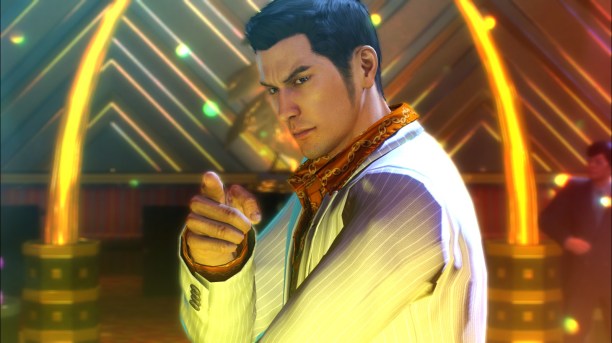
Kiryu was established as a badass from the outset of the first game, possessing a reputation for being strong and respected. He was well on the rise through the ranks of the Tojo Clan, and might’ve established his own yakuza family were it not for the murder accusations. His subsequent decade-long stay in prison and reestablishing himself in a thoroughly changed world are at the core of the first Yakuza, and I had experienced enough of that to get a sense of Kiryu going into 0. But from the very first outset of that game, the Dragon of Dojima is a known factor… even if he has to work out a little bit after such a stint behind bars. It’s only up from there for Kiryu’s power during rest of the franchise.
Not so in Yakuza 0.
Here… he’s a lowly enforcer for the Tojo Clan, standing out mostly for his raw brute strength and strong personal moral code. He’s still the generally stoic and implacable character that he has always been, but he comes across as more fresh and a lot less refined. And so it is that he very quickly gets into trouble as he’s accused of killing a man he’d just roughed up to collect loan payments from. Of course, that doesn’t really explain why the guy was shot to death, but it’s Kiryu’s word against the rest of the clan it doesn’t go well.
From there, he has to find out who framed him and why. It quickly turns out that the empty lot on which the dead guy was found is a particularly piece of real estate, and now there’s a massive conspiracy that Kiryu must uncover over who can get that land despite the corpse… and not before he gets to beat the crap out of the Tojo Clan captains who are all fighting over it with him as collateral.
Your average Yakuza game can be a little bit of a slow burn for people not expecting it. It will open with a number of cutscenes that tend to be made with a big focus on cinematography and dramatic tension. Long pauses, long dialogues, plenty of focus on character expressions and responses. Though that first initial hit may be off-putting, I found that it really doesn’t take long to just pull you in with how well constructed it is in presentation. If you stripped the open world aspects away and were left with only the cutscenes and story set-pieces, you would have a really fascinating crime drama on your hands. But the major reason that this works so well — in both the franchise and especially in Yakuza 0 — is the characters.
Kiryu is a fairly strong and likeable character, though he can sometimes be a little too much the stoic badass. The supporting cast helps to provide more levity and variety though. His childhood best friend Nishiki, who ends up becoming a much darker person during the events of Yakuza 1, is given a real chance to shine in his youth and play the more streetwise personality side to balance Kiryu’s blunt strength.
The various members of the Tojo Clan and the Yakuza world at large are all given interesting personalities and traits, some of which unfold more as the game progresses and they start playing their cards more openly. Plenty of them are explored far more in-depth than they were in the later games, as quite a few didn’t make it past the original title and were underutilised there, so this is welcome development.
No other character grabbed me in the entire damn franchise more than the second playable character in Yakuza 0, though. See, the game is divided up into a number of chapters, but after every two chapters the viewpoint character changes. This is usually how the scene will shift from Kamurocho to Sotenbori as well, though both characters will eventually move between both locales. Though they never actually meet at any point in the game, their plots and actions directly intertwine with and influence each other, and so they become tangled up in the same conspiracy with the same players.
The dynamic of the two is fantastic, as both have totally different viewpoints and backgrounds to further set them and their stories apart. In addition, they play differently in their combat and approach to problem solving, as well as getting their own unique side activities; one has a real estate mini-game, while the other runs a hostess club. But again, this dichotomy between the two shines best in the story, and I cannot stress enough just how well the game executes their paired stories separately while tying them together almost effortlessly.
I haven’t properly introduced the second character’s name yet though, have I?
He’s Goro-damn Everywhere
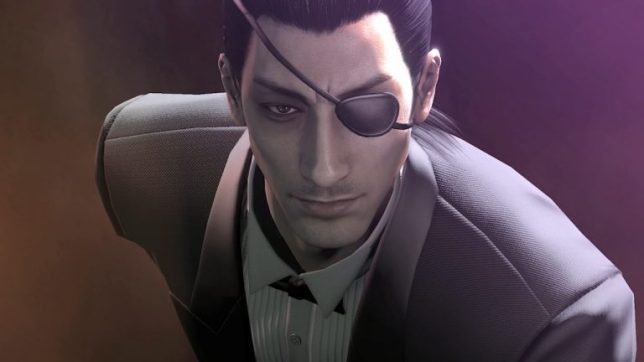
Goro Majima was introduced in the first Yakuza and has since been in every other game, usually featuring both as a boss fight (and a highlight fight for the game at that) as well as an ally to Kiryu and the Tojo Clan at large. But 0 was the first and only time he’s been playable outside of spinoffs, and his introduction here is… not what series veterans expected.
I’d already met Majima in my brief stint with Yakuza Kiwami, as he’s in one of the first scenes in the game. Two things are established by that interaction: 1) Kiryu is a badass, and 2) Majima is a goddamn lunatic. Known as Mad Dog Majima, he really did become something of the series comic relief, with the locales of his fights and his antics usually being incredibly over the top and ridiculous.
So when he’s introduced in Yakuza 0 as a suit-wearing, expensive club-managing, immensely poised and insanely suave motherfucker in one of the best introductory cutscenes in the entire franchise… well, it evoked quite a few questions of “How the hell did he go from this to what we’re used to?” Yakuza 0 will, over the course of its run time, answer that question in exquisite detail. And in doing so, they made Majima my preferred main character of the two, as well as my perpetual favourite character in the entire franchise from then on. There wasn’t a point where I came to dislike Kiryu, especially in subsequent games, but it nonetheless made the infrequent Majima appearances stand out all the more.
Well, excluding the Majima Everywhere system they shoehorned into Kiwami… that welcome wore out long before the content did. We’ll get to that shortly.
So Yakuza 0 had me swapping between the two leads every couple of chapters, usually at a good time to keep things fresh and varied. By the end of the story, I was absolutely enthralled and pushing on to ridiculous hours in the morning to see it through. From the final “point of no return” warning all the way to the emotional finish and both of the awesome final bosses (since each character gets one to fight), it was an absolute joy to play and left me grinning like an idiot even while shedding tears.
All this and I still haven’t spoken much about the combat, huh? Just goes to show you how much there is to like about this game without even getting into the meat of your actual gameplay time.
Yakuza 0 plays out like an action/brawler game with a hefty dollop of RPG mechanics. Your selected character wades into the thick of things with a fairly standard set of controls: one face button for light attacks, one for heavy attacks that changes depending on how many light attacks lead to it, one button for grabbing and throwing, another for doing a short dodge, and a guard button on the shoulder trigger. It’s easy to pick up, but ends up with a lot more depth in the more intense fights than something like a Dynasty Warriors title, since you’ll frequently need to guard, dodge, and utilise other special tricks that unlock as you progress.
Two of the most notable things about the combat are the Heat Gauge, and your combat styles. In addition to the health bar, the heat gauge builds up as you hit things or use certain items (or get drunk) and lowers as you get hit or spend it. The more full the gauge is, the more bonus stats and other effects you’ll have. However, you can also spend your gauge by pressing the heavy attack button when the Heat icon flashes, and this will do a special Heat action… and this is absolutely where the Yakuza battles become total spectacles of brutality and over the top violence.
The time and place of these Heat actions is entirely context sensitive, and unlocking or finding new ones at specific places or situations can bring a whole new moment of joy — or schadenfreude — to a battle. Shoving enemies into car doors and closing them, throwing them through glass windows of convenience stores, utilising various items like bowling balls or cinder blocks or golf clubs… I’m sure you can imagine just where the game will take itself at times. The moves are powerful, significant, flashy and a real tide turner, but it always comes at the cost of not having those passive buffs granted by your Heat gauge.
And then we have combat styles. Earlier Yakuza games featured just the one style that grew over time as Kiryu progressed through the games, and the only real variety was in weapons you might find or when multiple playable characters brought their own fighting styles into the mix in later titles. Coming right after Yakuza 5, which featured five playable characters (though only four had combat styles), going back down to two might’ve felt like a let down, so the team compensated by giving three styles each to Kiryu and Majima.
Their base style is fairly reminiscent of how they would fight in later entries, but far more rough and unrefined. Early on in the game for both, though, they will witness someone using a style or concept that seems awesome and they just have to utilise it for themselves.
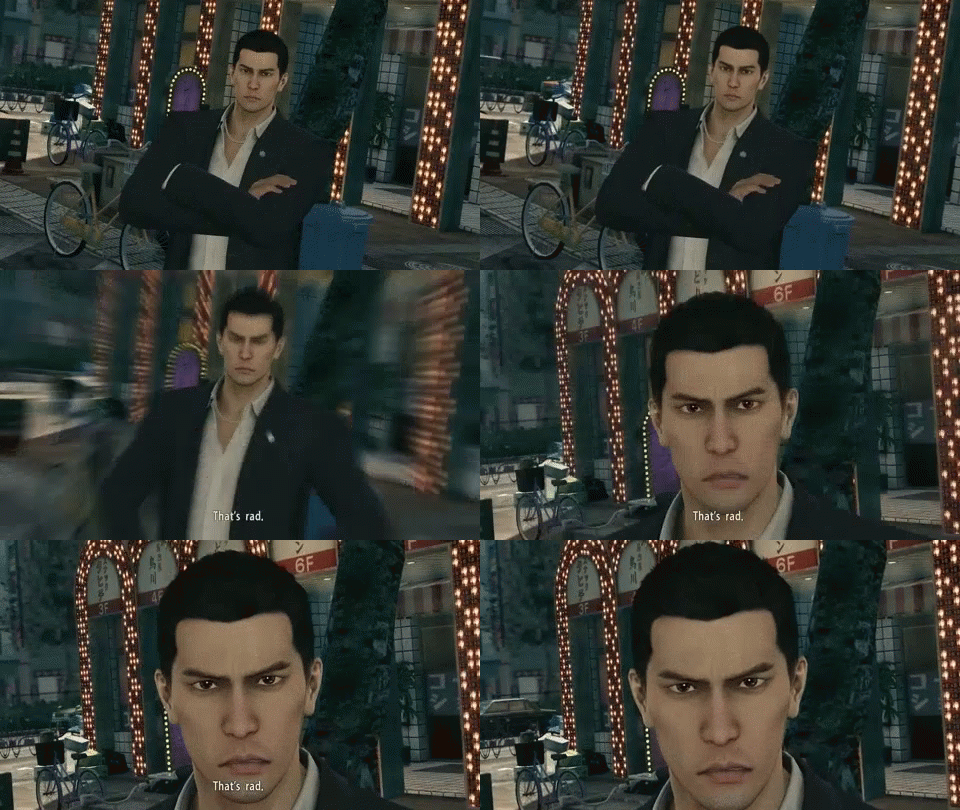
So from his base Brawler style, Kiryu gets a very boxing-like Rush style where he’s light on his feet and strings lots of fast attacks together into easy stuns. He also gets a style adequately named Beast where he just overwhelms people with raw power, shrugs off staggers and hits through sheer willpower, and passively picks up environmental items up to and including motorcycles to beat people up with.
Majima, on the other hand, starts with the Thug style that is far more lithe and kick-heavy than Kiryu, packing some very wild and unpredictable moves befitting him. But then his extra styles go for something far more bonkers. His answer to Beast style is Slugger, where he just pulls out a baseball bat and goes to town on people. Instead of Rush? He gets Breaker, where he literally breakdance fights people.
Yes, it is just as fantastic as you’re probably picturing in your head. You even pose after actions to generate extra Heat.
Furthermore, you’ll find a variety of weapons through the game that have a variety of effects and power but limited durability. They’re effectively tools you can use to vary things up or turn the tides of a tough battle. There’s also an unlockable fourth style for each character, but these are more like treats for completionists than primary styles. I didn’t even get them during my playthrough, as they were entirely bonus options. These would be the Dragon and Mad Dog styles, which are far more reminiscent of the fighters they would eventually become. Awesome though they are, you won’t be using them for much of the game compared to your primary three.
You can swap between these styles on the fly, or just focus on the ones you like. Each have their strengths and weaknesses, as well as their own progression tree. Said progression is where the RPG element comes into play, as you can spend money and experience to unlock new skills, traits, passive stat increases and other such bonuses.
As for why you spend money, well… it was a boom economy for Japan in 1988, so that means the money is flowing freely. Beating someone up in fights will see yen bills explode out of them, bonuses in combat and side activities shower you in cash, and the figures you amass get pretty ridiculous in no time at all. It feeds into the story, the mini-games, the presentation, the combat… everything.
I guess that’s why I’ve been able to spend this long talking about Yakuza 0 alone without really getting too deep into any one of these topics. Every little aspect of it feels important to me, and it all ties together into a larger and more glorious whole than I would have expected. It’s not just the combat, the story, the characters, the presentation, the location, the kickass soundtrack, the slew of side content and minigames… it’s the way all of this just feeds into each other seamlessly.
So I powered through Yakuza 0 relentlessly once I got into the swing of things, shed manly tears at the conclusion, and was instantly and irrevocably a Yakuza fan. Though the overall package was fantastic and the story a very complete and satisfying one, I just wanted more. Thankfully, I already had more! So I dusted off Kiwami and got to it.
I won’t talk about each following game for quite as much as I did 0, but you can rest assured that barring mentioned exceptions, all the games feature these aspects in some way or form.
Kiwami Means Extreme
Yakuza 0 was the last “new” Yakuza game to be released using RGG Studios’ old engine. Later mainline games instead use their Dragon Engine, which features more physics interactions in combat, and more seamless movement between buildings and streets with less loading screens. There’s a number of general performance updates as well. Unfortunately, the combat initially suffered teething pains from this engine shift, but each game since has utilised the engine far better, so hopefully we’ll get back to that high point before too long.
Yakuza Kiwami was not built on this engine, so this segment is entirely arbitrary to the current topic!
Well, okay, not really. See, with the Dragon engine being developed and utilised for future games, Kiwami was made a little more cheaply and not as a brand new title from the ground up. In short, it takes the engine and systems of Yakuza 0 and applies a map pack and overhaul to it in order to make it a retelling of the original Yakuza. Saying it like that is kind of a disservice to how impressive a remake it is, but we’ll get to that; I just wanted to set the groundwork for what’s to come.
So while Yakuza 6 was in development to finally push the ongoing saga of Kiryu Kazuma forward in contemporary times, Yakuza Kiwami was a means of modernising the original title for those who hadn’t yet experienced it. Given that the game was 10 years and two console generations old at this point, it’s entirely understandable. And quite frankly, they did a damn good job of it!
The core mechanics of Yakuza 0 remain as strong as ever, and the multi-style fighting system made the combat a little more varied than the original. Kiryu keeps all of his 0 styles, with his unlockable Dragon style available from the get go. This one starts out underpowered though, and he gradually redevelops and improves over the course of the game in order to fully reach the heights of power he had before prison. As such, it doesn’t get much use until the game progresses.
Beyond that major combat change, the original Yakuza is reintroduced in immaculate detail. Seriously, the city layout and buildings are as they were in the original, but the fidelity and detail is cranked up hard, and it still maintains many of the side activities that 0 introduced.
This carries over to the story beats and cutscenes as well. The slow building tension and overall crime drama presentation is maintained, and comparison videos will show just how well they translated the original scenes to modern looks. It’s both a testament to the craft of the studio and a general nod to how well crafted the original scenes were despite their technical limitations of the era. The characters are emotive and interesting, with each standing out and their expressions and personality quirks on display in immaculate quality.
So with all this said, coming from 0 to Kiwami was a pretty good move. I was already entrenched in the franchise on a hitherto unforeseen level, so coming back here and seeing where it all began was particularly eye opening and still quite enjoyable! On the other hand, it also better equipped me to tolerate some of the issues that came with the remake, because they do exist.
Much of the original game is copied over in its entirety… up to and including some outdated mission designs and issues. Some of the later story set-pieces feature excessive use of enemies with guns, explosives, and excessive knockbacks that are really not entertaining to deal with. The last major fight before the final boss fight is an unfortunate example of this, and among the worst fights of the entire franchise before they learnt and adapted. Even so, preserving this as it was makes for a less than brilliant experience at times, but such is the price for being an overly faithful remake.
There are issues with the story’s pacing as well that make a return from the original incarnation. Overall, the story is pretty solid and builds to a pretty satisfying crescendo, but I feel like a few too many of the big reveals and twists happen in the last 10-20% of the game and could stand to be spread out a bit. Once again, this is something they adjusted in later games, but for the remade romp through history, it’s here to stay.
Perhaps the biggest issue is actually one of the major selling points of Yakuza Kiwami: the inclusion of a new system called Majima Everywhere.
Majima appeared in the first game as a henchman to one of the primary antagonists, and popped up in a couple of places to cause Kiryu a headache. You fight him twice in the story, and both are very memorable appearances and awesome boss fights that cemented him as a fan favourite character. His appearance in every Yakuza game that followed is testament to that, and his obsession with “Kiryu-chan~” and getting an awesome fight out of him is series tradition by now. But since Kiwami was made utilising 0’s engine and systems, they must have thought it’d be a shame not to reuse his movesets and such.
As such, right after returning to Kamurocho from prison, Kiryu is accosted by Majima in a brand new scene. And Majima becomes so obsessed with Kiryu and disappointed that he doesn’t get to fight him at full Dragon of Dojima strength that he starts going out of his way to train Kiryu up there. Hence, we have Majima Everywhere.
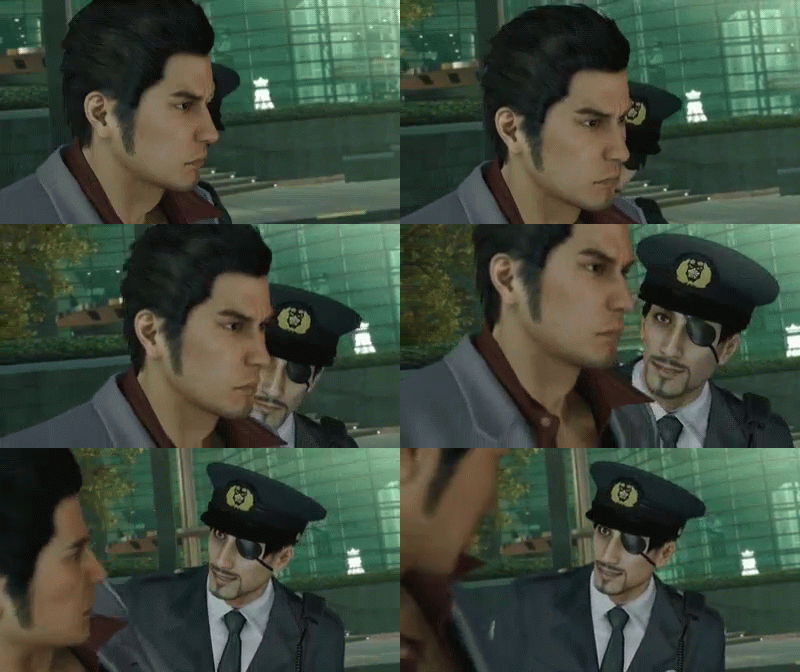
Every so often, you’ll be roaming various parts of Kamurocho, and Majima will jump you and trigger a miniboss fight using one of his various styles from 0. Sometimes they’ll be telegraphed encounters on the map, other times they’ll have whole side quests and silly antics around them; Majima will be dressed as a hostess, or a police officer, or a zombie, and some scenario will play out that culminates in a fight.
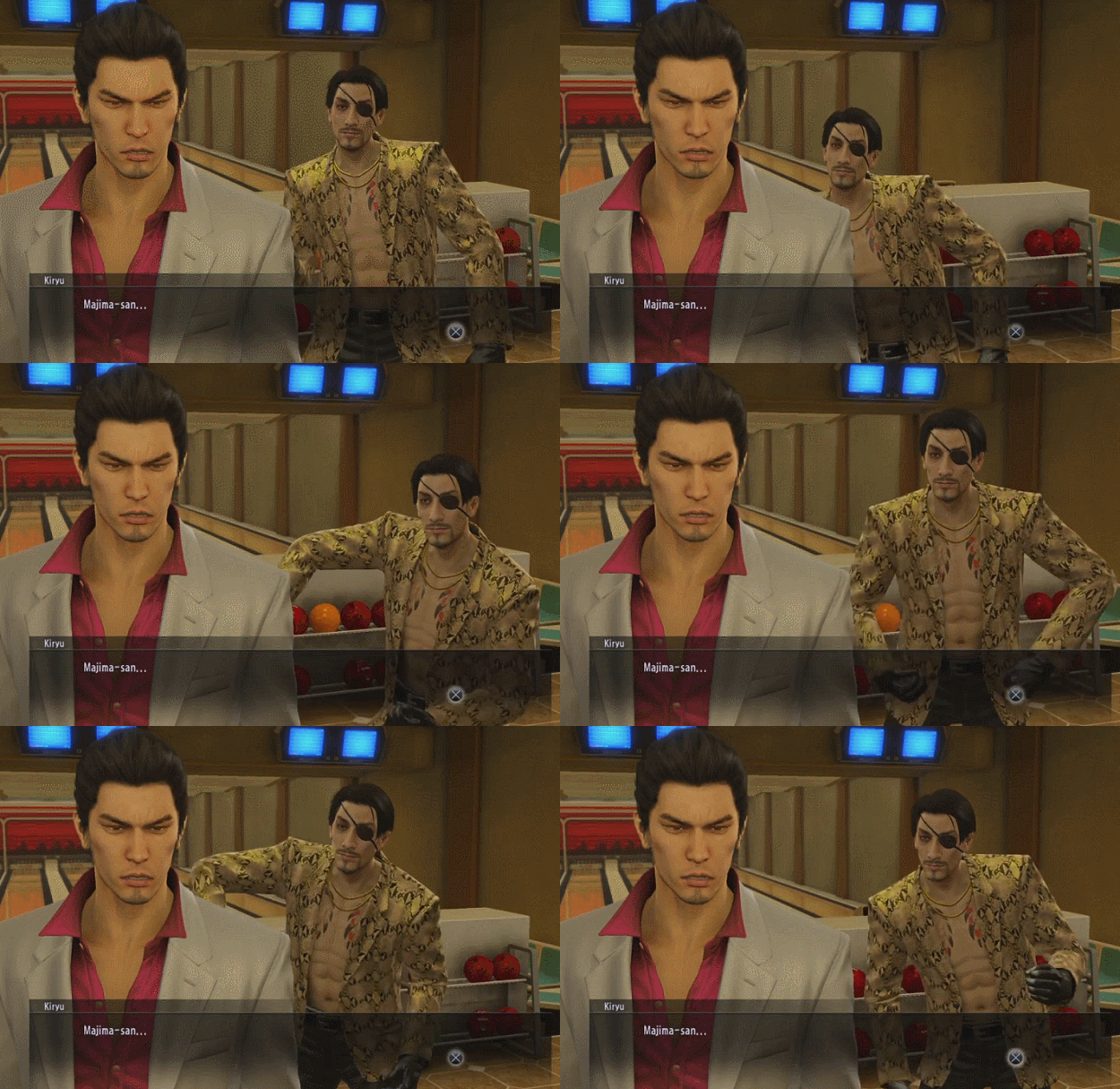
This system is at the heart of your Dragon style, and in order to fully unlock the full suite of abilities to make that fourth style more usable than Brawler or Beast or Rush, you really have to hunt down the Majima encounters wherever possible. But you have to do it a hell of a lot to even make it particularly worthwhile, and though the individual vignettes and fights can be great, it quickly wears out its welcome long before you’re through.
What’s especially egregious is that in order to justify these constant clashes with Majima, the circumstances of the plot and his original canon appearances had to be tweaked to make it work. So there is a brand new scene shortly before the second fight with him in which he’s “disposed of”, allowing for him to be out of the picture for a while as well as be injured when he does fight you… which, originally? Was an injury as a result of that first canon fight with him. And given that the new injury is gained in service of protecting you… having him return eager to kick your ass without that familiarity is a stretch. It skews things about and just feels quite awkward, all in order to accommodate this system. So while it’s a neat idea, the execution is a bit rough.
And that’s basically Yakuza Kiwami. I played through it not long after 0, and ultimately enjoyed myself quite a bit. The original plot holds up despite the few inconsistencies, and I was once again satisfied with the tale and looking forward to what was next.
I didn’t have to wait long, as later in 2018, Yakuza Kiwami 2 was released in the West. As the name suggests, it took the original Yakuza 2 and gave it a big graphical and mechanical overhaul, but this time using the Dragon engine that Yakuza 6 utilised. Said game was still a bit rough as I mentioned in that section opener, but Kiwami 2 tightened up a few of the systems for a better overall experience. It also had a much larger world, featuring a bigger section of Kamurocho than 6 featured, as well as being the “first” appearance of Osaka’s Sotenbori in series release order (even if it was already known to me personally thanks to 0).
Even now, having played the entire series since, Kiwami 2 is second only to 0 in my Yakuza rankings. This game is just… fucking excellent. A more interesting and better paced story that built nicely from the first and expanded it in so many areas, not the least of which was the landmass. Further character development for the cast, new and old. A fantastic new antagonist in the shape of Ryuji Goda, a return of some of the better minigames from 0, more awesome fights and activities and music, one brilliant ending… Yakuza 2 really was the high point of the franchise for a good long while, and the remake holds true to that in my eyes.
Perhaps the only reason why I wouldn’t consider Kiwami 2 for the best position in the franchise is due to one section in the middle of the game that came out of nowhere and totally broke my suspension of disbelief. It was so very bizarre and I couldn’t comprehend how or why it was happening, and it was honestly jarring enough to pull me from the experience entirely. If not for the fact that this section culminates in one of the most legendary moments in the franchise that is over the top in a good way, it would have a lot to answer for.
But it’s okay, because it culminates in Kiryu punching a goddamn tiger. So I guess it balances out somewhat
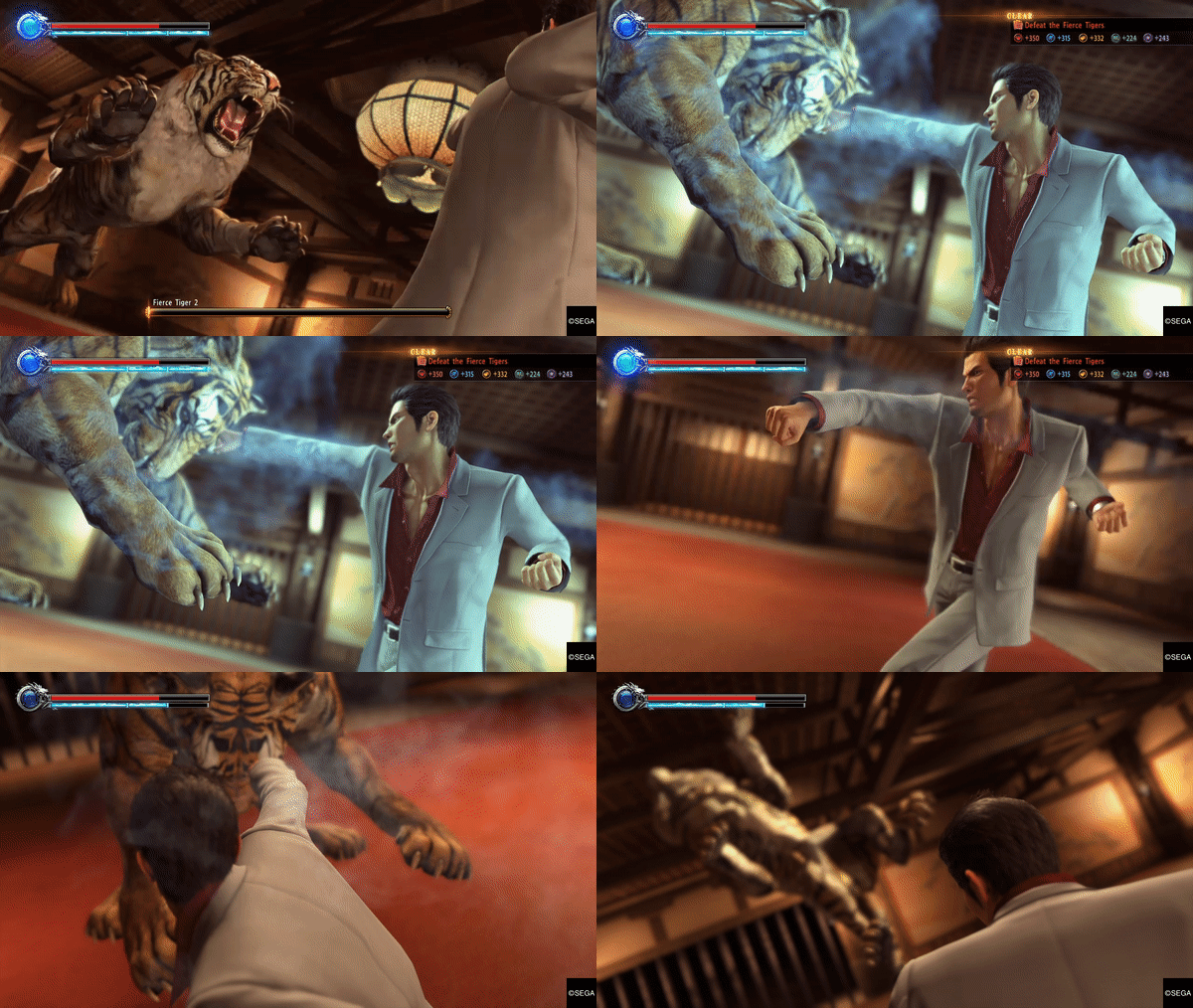
Playing those three Yakuza games in particular over 2018 really stood out to me, and from then on it was difficult to find a moment that would reach that high point again. That’s not for lack of trying, but the games after that point were a bit more of a mixed bag than the solid monoliths of excellence that I feel about 0 and Kiwami 2. The year was capped out by the Fist of the North Star spinoff made by the same studio; transplanting that utterly ridiculous Yakuza action and general game flow into the ultraviolent, exploding heads aplenty setting of that series turned out to be a match made in heaven, and I loved that game also.
Still, though, I found myself wanting more. I was hooked, and there were times when not playing Yakuza for a while felt like I was going through withdrawal symptoms. It’s honestly, actually been rough in the months since I concluded the series. I just… find myself without more of it to play, and it irks me. But that began even late in 2018, so it was only a matter of time before I sought out the remaining titles.
Yakuza 3 was a PS3 title, while its two predecessors had been PS2 titles. They were much more in need of a full Kiwami style overhaul, but that hefty process and full development cycle really didn’t need to happen for anything after 2. Instead, Japan had gotten HD re-releases of Yakuza 3 and was due to get 4 very soon. There had been tentative talks about releasing these in English, but with the almost traditional case of Sega not being fully clear when or if that would happen, I decided to set myself a deadline: I would wait until the 1st of January in 2019, a couple of months after I’d wrapped up the others. If there was still no confirmation of an English release date, I would track down a copy of the PS3 game and play that instead.
2019: Year of the Dragon (of Dojima)
I think my copy arrived in the mail on January 6th or so, and I immediately dusted off the PS3 and started playing.
Yakuza 3 is generally considered one of the low points in the franchise by many, and I can honestly echo that sentiment, but not vehemently. It has pacing issues all over again, and the localisation was in an awkward spot that clashed with the remakes on some names, so that was awkward. The plot seemingly felt the need to escalate further in the trend of Yakuza 2, so there’s a lot of twists and crazy conspiracies that build up to the point of being a bit much. It was also naturally a step back mechanically from the games I had already played, but given that they were all made years later, I can’t genuinely hold that against it.
Despite such claims though, I powered through Yakuza 3 and had plenty of fun doing so. I enjoyed the story, thought the new antagonist was interesting, and even enjoyed the time I spent managing the orphanage on Okinawa and looking after the orphan kids there. They all had their own little characters and arcs, and seeing Kiryu struggle to escape the criminal underworld and just be the person he wanted to be without incident was heart-warming to see and experience. It had climax moments of its own that were up there with the tiger punching scene, had some emotional sucker punches, and generally delivered a well rounded product despite the rough edges.
In short, it was more Yakuza, and that’s what I wanted. There are so few other games like this; the combination of deep and character driven stories in that crime drama space, with the more focused and controlled open world gameplay and tight brawler combat. Even at the lower points in the series, I was still so enthused and invested. I was now four games down, and wasn’t about to stop.
By contrast to the year before, I was free to follow up almost immediately rather than wait for additional releases, so I pretty much ordered a copy of Yakuza 4 while the credits for 3 were rolling. It was in my console pretty much the moment it arrived, and on I went.
Like 3, this game wasn’t received as favourably as others in the franchise, but I personally felt it ranks quite highly. It features the first inclusion of multiple playable characters, and sees Kiryu joined by three others: the freakishly strong Saejima (off which Kiryu’s Beast style would later be modelled), the crooked cop Tanimura (who features a lot of grabs, takedowns, arm locks etc.), and stylin’ loan shark Akiyama (a fast, kick-heavy fighter and my absolute favourite character in the franchise after Majima).
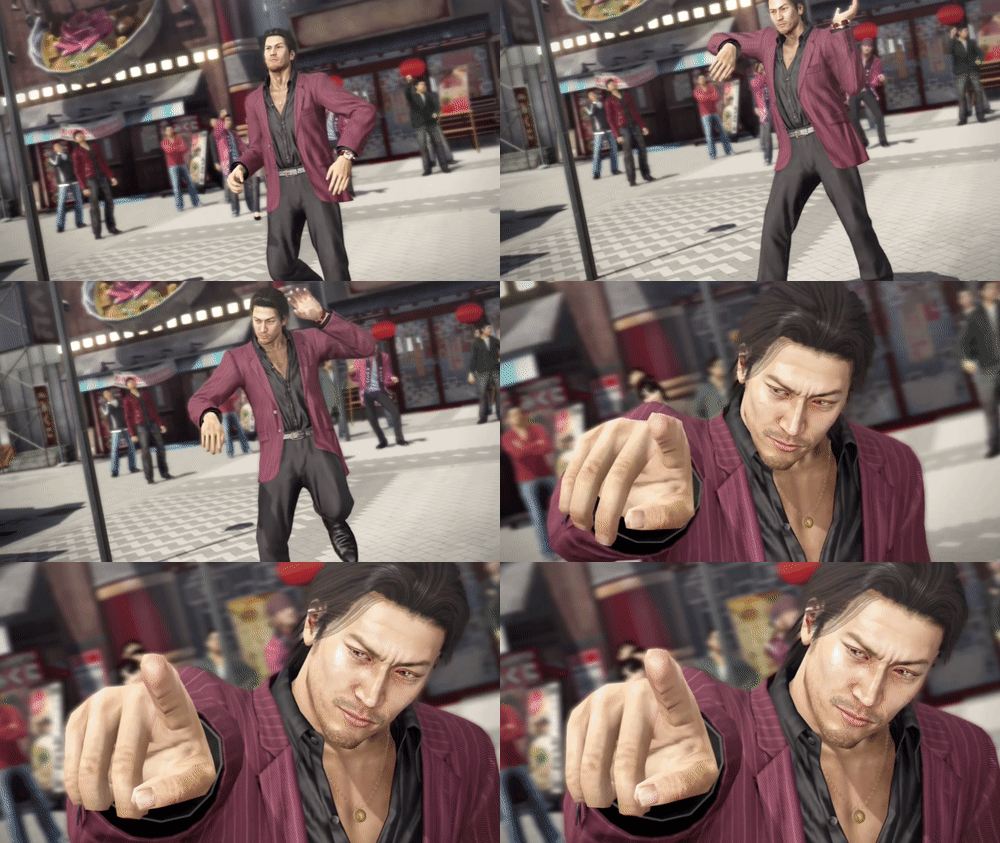
Seriously, look at him. Akiyama is awesome.
At various instances in the story, the player character will change and you’ll experience a section of the plot that pertains to them. It opens with Akiyama, then Saejima, Tanimura, and finally Kiryu to wrap it all up before allowing you to swap as you see fit. There are four final bosses encounters in sequence, serving as one final big action set-piece to conclude each story. But up until that point, the continuous plot thread runs through each character’s tale in ways that you wouldn’t necessarily expect.
What’s particularly interesting about Yakuza 4 is that Kiryu isn’t present from the outset. Like I said, it opens in Kamurocho featuring Akiyama as the playable lead. With the upcoming Yakuza 7 being the first numbered game to not feature Kiryu as front and centre, Akiyama is the kind of character I could easily have seen taking the centre stage. There was almost no period of uncertainty where I wasn’t meshing with this character or was wondering when I’d be ditching Roxas to play as Sora; 4 could’ve been the Akiyama show, and I’d have been perfectly fine with that. I’ve got no doubt the series will continue just fine with Kiryu’s arc concluded. But I digress.
As it stands, Kiryu is the last playable character of the four, but he does appear earlier in the game: you fight him as Saejima, and he is absolutely terrifying. I found him to be perhaps the toughest fight in that game, and not just because I’d yet to fully figure out Saejima’s playstyle, but because it’s goddamn Kiryu Kazuma. With this many experiences under his belt, it was only fitting that he was in peak fighting form, and even holding back against Saejima it was an amazingly good fight. That kept the need to play Kiryu from being too strong, since I knew he was at least being done justice. In addition, having him be the last character means he can enter the scene with many of his abilities and techniques unlocked and ready to go, which is awesome.
The four characters here each go through their own little arcs while tying them all together into the larger plot point and conspiracy, and it culminates in a pretty grandiose way. It’s got a lot of awesome moments for all of them, though Tanimura is probably the most forgettable of the cast — his story is fully started and concluded in this game, and he never ends up reappearing in the series compared to everyone else. Nonetheless, I liked him while he lasted here, and he wasn’t at all unwelcome. It’s not as though his parts of the story were bad, far from it. They’re just not tiger-punchingly awesome, is all.
If I had to pick a weakness of Yakuza 4’s, it’d be that the plot was really starting to buckle under its own weight. Like 3 before it, 4 just had to be bigger! Grander! More convoluted! More twists, fake outs, shocking moments! Seriously, there are something like four or five different fake out deaths in this game, and by the end of it I just assumed nobody was actually dead until the very conclusion. For some, it ends up crossing the line into being too unreasonable and unbelievable, and I definitely felt it was straddling that line for quite a bit. But for me personally, it never quite strayed too far to where it broke, and so I stuck with it to the conclusion and still had a grand old time. It was certainly the closest of the PS3 titles to reach the grandeur of 0 and Kiwami 2… and that includes the one that follows.
So let’s talk about Yakuza 5.
…

Yakuza 5 can fuck right off.
In general ratings lists and discussions of favourites lists, 5 is generally listed on the higher end of the franchise, and routinely regarded as the best of the PS3 titles. I was looking forward to it, since it was supposedly the most expansive game in the franchise that wasn’t 0. More playable characters, more playable cities, and a bigger and grander plot full of twists that beat out 4 in that front. What’s not to love, right?
Well, if you scroll up and read what I said about 4’s plot issues, that’s probably a worrisome sign to you. In the end, Yakuza 5 is my least favourite game in the entire franchise. It’s the one and only time I felt fatigued and frustrated to the point of not wanting to go on. For every other game in the series, I was sad or satisfied (or both) by the time I hit the credits.
My response to the credits rolling in 5 was a sigh of relief as I dropped my controller and yelled “Thank fuck it’s over”.
Despite having plenty to like about it, so much of it just completely buckled under itself and left me feeling increasingly frustrated and annoyed as it progressed. So what happened here? Well, they have five playable characters this time around. The playable cast of 4 all returns except Tanimura, who is replaced with…
…I actually don’t remember his name, I need to look that up. That should tell you something further… Right, he’s called Shinada.
So Kiryu, Akiyama and Saejima are joined by newcomer Shinada, an ex-baseball pro. The fifth playable character is long-time series veteran Haruka, the orphaned girl from the first title that Kiryu has basically since adopted. However, she isn’t a fighter, and instead her section of the game actually has her undergoing the process and training of becoming an idol. Her combat is entirely rhythm game dance-offs, and that entire section is honestly one of the highlights of the entire game to me.
Since Haruka has her extensive rhythm game sections, every playable character basically has their own dedicated mini-game side story section. Akiyama lacks this, as his story basically intertwines with Haruka’s and allows him to serve as the combat section of her chapters. Shinada, being a baseball player, basically takes the batting cage activity of the series and turns it into a mini RPG that I found completely forgettable. Saejima ends up taking up deer hunting in a rural mountain village, so there’s a fully functional hunting sim in there that’s kinda fun.
But Kiryu? Kiryu is moonlighting as part-time taxi driver, part-time Initial D character.
And this all ties into the plot. See, Kiryu has grown tired of the yakuza life endlessly returning to haunt him and his orphanage, no matter the efforts he takes to try and distance it. Combined with this constant pressure is Haruka’s burgeoning idol career, and rather than cause potential scandals by her connection to him becoming known, he chooses to live in solitude and support them from afar.
This time around, Yakuza 5 opens with Kiryu from the start. Despite his disappearance, even now he gets dragged into the business of bailing out the Tojo Clan and his yakuza comrades yet again. The conspiracies have gotten bigger, the cast even more extensive, the plot twists even more ridiculous, and the overall story too damn contrived. If 4 straddled the line between believable and ridiculous depending on how you approach it, 5 makes a running leap off the line in no time at all, and just keeps on charging in that direction.
I honestly don’t care to go into it. I really don’t. Kiryu’s section is fine, albeit a little dreary since he’s understandably depressed from his separation from Haruka and the life he’d been trying to make. This follows with Saejima’s section, which is… fine, I guess. Didn’t really stand out. Haruka’s section follows, and while it’s quite good on its own, the connection it has to the larger plot is quite tenuous at first. Once the connection is revealed… well, let’s just say I actually yelled “WHAT” at my TV in total disbelief when it happened. It was pretty ridiculous, but it wasn’t a complete deal breaker, and that was when Akiyama entered Haruka’s plot and made me start grinning again. That was a welcome reprieve.
Nonetheless, the plot was already struggling under its ambitions by this point. Enter Shinada’s section, where the entire thing just crumbles into dust.
Shinada is tangentially connected to the entire thing. There’s a conspiracy relating to his failed baseball career and the scandal that ended it, and this features a connection to the head of the Tojo Clan who has gone into hiding in order to solve it with him. And quite frankly… it’s just dumb. The whole thing goes nowhere, is ridiculous, and even if I can see the connection to the grand scheme of things it still just felt entirely unnecessary and could’ve been shaved off. Shinada himself is a decent enough character, but his entire story felt like an unnecessary afterthought that was only in there because they wanted to tell a spinoff tale about baseball. I didn’t care for him in combat, either, so I was very ready to be done with him once the final chapter rolled around.
Well, the final chapter rolled around. The plot continued to disintegrate as it went, even with a few moments that were kinda cool, and then pulled out one last surprise twist in order to create an epic final fight for Kiryu to tackle. But… even if mechanically it was intense and grandiose, I was honestly just gritting my teeth the whole time at how forced and unearned it was.
How can I describe this? Well, imagine if at the end of the Lord of the Rings movies, it turns out that everything had been engineered solely so that Sauron could elevate Gimli into the true successor to the world, and so there has to be a massive showdown between Aragorn and Gimli where Gimli just fights so far beyond anything he has ever been shown to be capable of up until now. It’d be something like that. Quite frankly, it’s awful.
Despite the occasional moments and the general level of fun that is pretty much a guarantee in any Yakuza game due to mechanics, I couldn’t stand Yakuza 5. I had to drag myself through it kicking and screaming, and the only thing I felt when I finished was relief that the torture was done. If I were ever to replay the series, I would never replay 5. It is easily, hands down, inarguably my least favourite game in the goddamn franchise. Not even Kiryu drifting in a taxi or Haruka and Akiyama dance battling their way to victory is enough to make up for it.
I was so exhausted and frustrated by the conclusion of Yakuza 5 that I decided I seriously needed a break from the series. I’d been powering through these games one after the next since the beginning of the year, and with only one numbered title left (and spinoff title Judgment about to release), I figured I was in no rush to keep on going. So began my hiatus for new Yakuza titles.
This lasted about three days, whereupon I bought and started Yakuza 6.
I’m not joking about the withdrawal symptoms, guys. Please send help.
Now, plenty of people consider Yakuza 6 pretty lackluster in the grand scheme of things, and I don’t blame them. Released after 0 and using that new-fangled Dragon engine, it felt almost more like a tech demo that was incomplete. It scaled back to only having Kiryu playable, and his moveset felt a lot more stiff and limited than before, and no amount of physics engine silliness could make up for it. Picking up a thug and throwing him through a convenience store window before following him in and breaking the shelves on his head in a seamless process is pretty satisfying, but the novelty didn’t last the whole game.
Kamurocho is smaller than it had been previously, with previous areas walled off or inaccessible. It does jump between a district of Hiroshima called Onomichi to complement this, but even the two combined still feel somewhat lacking. Many of the series regulars are only briefly in the plot and relegated to cameos, with mainstays like Majima, Saejima, and Daigo only appearing at the beginning and end. Akiyama is at least a core part of the story though, and even if you don’t play as him he does help out Kiryu and appear on numerous occasions.
Despite all of this though, the actual story that Yakuza 6 tells is immensely more grounded than it has been for quite some time. There is a big conspiracy with a pretty grandiose reveal, but it’s built up in such a way and just blends naturally with the character drama being told. The new crew of characters in Hiroshima are endearing and lovable far beyond what I was expecting, and I generally came to like them and their arcs over time.
But more than anything else, this is basically the conclusion of Kiryu’s story. He’s been at the forefront of the six sequential Yakuza games, with 0 making seven. He’s risen to the top, left and reentered the yakuza business multiple times, and has tried forever to run from his past or just move past it without being able to. So this being a more grounded and personal story for him is honestly called for, and that’s exactly what it goes for.
In short, it’s all about Kiryu’s relationship with Haruka. He went back to prison for a couple years after Yakuza 5, only to find that Haruka has disappeared in that time. When she does surface, she’s comatome in hospital after she was hit by a car… in order to protect her infant son. Now, suddenly, Kiryu has to find out why this happened and track down the mysterious child’s father in Hiroshima, which leads back into that conspiracy I mentioned earlier. But ultimately, it’s a really sweet story that sees Kiryu develop even further from what he’s been thus far, trying to set things up so those that mean the world to him can be happy and safe.
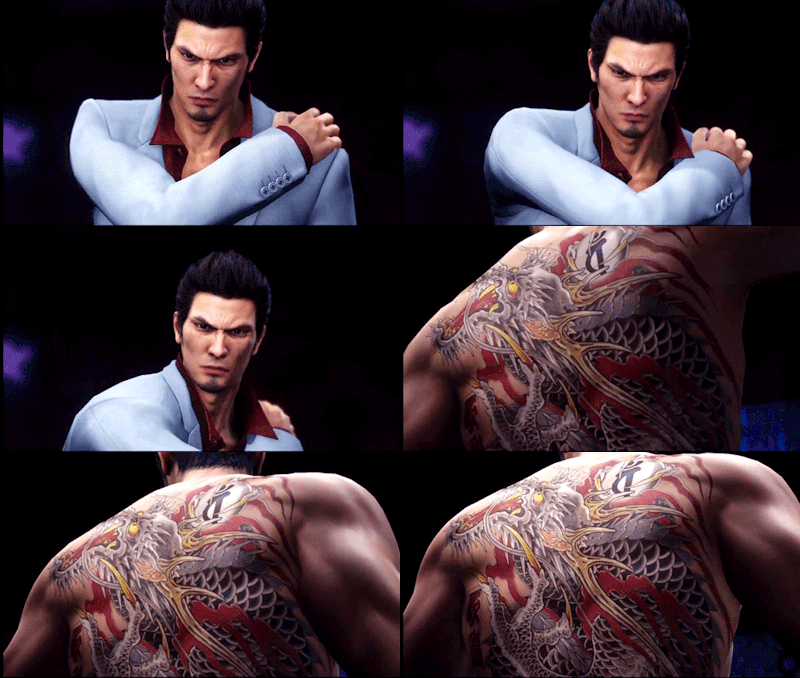
Now I don’t rate Yakuza 6 highly in the franchise as a whole. But the ending? The ending section alone elevated the entire game to stand much taller, and I honestly give it a separate entry in my rankings just because of that. Once the conspiracy is out in the open and the antagonists have a face and motive, the final fight with the villain is a drawn out affair in which Kiryu gets the shit liberally kicked out of him in order to protect Haruka and the others. It is honestly one of the most utterly badass, hardcore moments of Kiryu asskickery in the franchise, made all the more intense by the fact that he won’t even try to resist until he knows he can do so without repercussions to them. I won’t spoil how it ended, but the overall sequence of events at the conclusion was immensely poignant and had me openly crying, and I was genuinely glad to have experienced it.
And with that… I was done. In the span of about two years, I had utterly devoured seven whole large open world games in a series I had barely known existed before with almost no hesitation. And it was amazing. Now, at last, I could maybe take a legitimate break and move on to something else–
Judgment: Street Lawyer Detective Action
So Judgment came out in the middle of the year, and was centred around an entirely new story and cast of characters separate from that of Yakuza. Nonetheless, it was set in Kamurocho featuring many similar systems to the original series. There’s the same general notion of exploring and living within a very densely packed but smaller open world, the same variety of side activities, and the same sense of stupidly over the top fights. It’s a chance to take everything learned from Yakuza and make something new and stand alone, polished as best as they can.
And polish they did. This is easily the most functional and feature complete use of the Dragon engine thus far, with one of the most expansive Kamurocho maps to date. The side content has a broad mix of familiar favourites and some extensive new ones, including a Mario Party-esque mini-game, an extensive drone racing game that’s as feature complete as some full racing games, and lots of other fun stuff.
But what’s front and centre over Judgment is the writing, because this is probably the strongest showing of plot, character, and general writing the franchise has had to date. See, as the name and the subtitle up there suggests, we aren’t playing members of the yakuza anymore: we are playing a detective on the streets of Kamurocho.
Takayuki Yagami is the new front man, a former street tough who was uplifted by a well-meaning Tojo Clan patriarch (can’t completely abandon the yakuza premise) to become a lawyer. He passed the bar exam young and established himself very early. The court system in Japan is notoriously rough, with something like 99% of cases ending in a conviction — a fact that was the basis for the Phoenix Wright series of games, which Judgment even references.
Yagami actually gets his client an acquittal in his first case, a rarity even for experienced defence lawyers. Just as he’s riding the high of this, however… the man he proved innocent of a murder is arrested once again under suspicion of murdering his girlfriend and burning down their house.
This sends Yagami plummeting downward, and so three years later the game begins with him having abandoned the path of the lawyer. Instead, he’s now serving as a private investigator in Kamurocho, often working with his former legal office but insistent on his new path. After all, a lawyer’s job isn’t to find the truth or solve the mystery, just to win the court case. A detective? They’re all about finding the truth in its entirety, and this is an obsession that Yagami has become driven by.
Judgment will very quickly kick off into a murder mystery in which a handful of yakuza members have been found murdered with their eyes gouged out. Suspecting a serial killer and quickly leading into a conspiracy between yakuza clans, the police, and eventually a medical research centre, the plot plays out in increasingly intense fashion much like it did in Yakuza before culminating in a stellar finish.
And it really is stellar. Everything that the developers had learnt up to this point is being utilised. The pacing is excellent, the drip feed of new information and developments is on point, the gradual uncovering of additional backstory and past elements of Yagami and co. feels natural and ties into the ongoing matters, and the mystery just gets larger without ever feeling contrived or overblown. It is truly a master class in writing, choosing to be less a crime drama and more a detective serial (fittingly). Each chapter even starts with a recap that plays out like a TV series might, reintroducing everything crucial to those who are tuning in after the last episode from a week prior.
Honestly, Judgment is brilliant. It’s the very best of what the Yakuza series has offered up to this point with a fresh set of paint and a new perspective that nonetheless flows into it greatly. Each new major development had me approaching it earnestly and trying to figure it out like a murder mystery. There’s enough breadcrumbs and teases to figure things out ahead of time if you pay enough attention, even while more developments and escalations continue to unfurl. I managed to successfully deduce who the major antagonist was about a chapter or two before the reveal, and it was genuinely satisfying to have that suspicion confirmed with a strong pay off. The plot really does ramp up, and the ultimate conclusion of the plot ties up many of the major character arcs — especially Yagami’s — and still provides one of the most memorable final boss fights in this style of games to date.
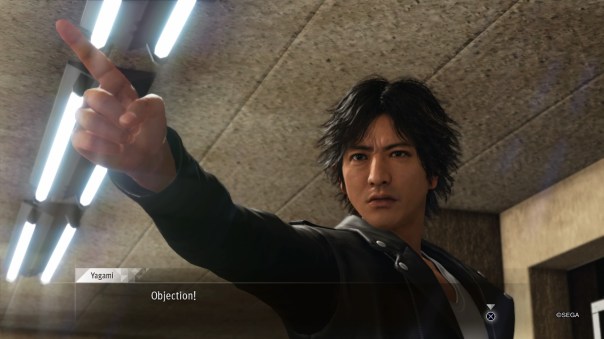
Perhaps the only reason why I still refuse to put this game up above Yakuza 0 or Kiwami 2 has nothing to do with the story, since it might very well stand above them. In truth, it’s actually the combat.
Up to this point, the Yakuza series has been swift, brutal, and visceral in its mechanics and delivery. While it features plenty of over the top moves and flashy Heat actions, the general feel of combat is tight and snappy. This might just be the nature of Kiryu and the other cast members when contrasted to Yagami, but his attack animations in Judgment are honestly flashy to the point of feeling drawn out. Even his basic string of attacks and combos feels sluggish, with the animations leading to delays even after upgrading your speed or cancelling the moves as best as it allows.
While I enjoyed myself and still found plenty of moments and fights that had me grinning like an idiot, I honestly just felt the combat didn’t stand out as much as the main games. And believe me, I would happily take another full game with Yagami’s combat over ever playing as 5’s Shinada again. Even so, the fights eventually started to drag a bit, so in the end I couldn’t quite place Judgment at the very peak of what Ryu ga Gotoku Studio has developed. Close… but not quite.
Nonetheless, if the thought of jumping into the Yakuza series would interest you if not for the sheer number of games, I’d heartily recommend picking up Judgment and using it as a gateway to the rest of the series. It’s a genuinely great time, and there’s plenty more about it that I love which I haven’t even touched on here. Like the soundtrack! The soundtrack kicks ass, and I’ve written the last half of this article while listening to a mix of it and Yakuza 0’s OST.
So yes. In summary, Judgment was great, and I am genuinely looking forward to another game featuring Yagami and friends in the future. If they’d like to continue this particular sub-series and alternate it with other titles, I would happily embrace it.
Like A Dragon
As I type this, the word count on this behemoth of an article is breaching 10k words, and future Delf the editor knows that it ended up even larger than that. I honestly didn’t intend to type this much, and just wanted this write-up to serve as a brief look at my time with the Yakuza franchise. But honestly, there is just so much to write about it, and there’s still plenty of things I have likely missed or failed to do more than scratch the surface of. Once I got typing, it was pretty hard to stop.
The level of content and details in this series is really just… incredible. The stories are great. The gameplay is great. The contemporary crime drama approach of games is strangely underutilised, often being left primarily to Yakuza or the far more over the top excess of Grand Theft Auto. It features stellar writing, brilliantly realised characters, amazingly addictive and fun combat or gameplay loops, and an altogether fantastic level of presentation. Everything about Yakuza is great.
There really is nothing else out there like the Yakuza series. It’s why, after dipping my toes in the water, I couldn’t help but dive right the hell in. And when I couldn’t find anything else that hit the same notes as it, it was only inevitable that I found myself devouring the entire series at horrific speeds. Ever since wrapping up Judgment, I’ve been left feeling the contentment of having consumed a fantastic banquet of food… but there’s still that knowledge that sooner or later, I’m going to get hungry again. Months have passed since, and the genuine feeling of withdrawal and sadness that I have no more Yakuza to play has continued to be present.
Writing all this up at long last has only exacerbated that, and I fully expect to tackle Yakuza 0 again shortly into 2020 to finally try and sate the feeling. I’m curious to see if it holds up as well as I remember, but I suspect it will.
Thankfully though, the Yakuza series isn’t done. Ryu ga Gotoku Studio — Like A Dragon Studio, which is also what the series is titled as in Japan — have continued to expand on this concept and prove themselves as exceptional developers. If not for their work boosting them, I seriously wonder if Sega would have even a modicum of their current success after their rough 00s. Further, Yakuza 7 is currently not too far away from release. In fact, it’s going to be titled Yakuza: Like A Dragon in the West.
No, I don’t know why they did that either. Not the greatest decision they’ve ever made, but hey, such is life.
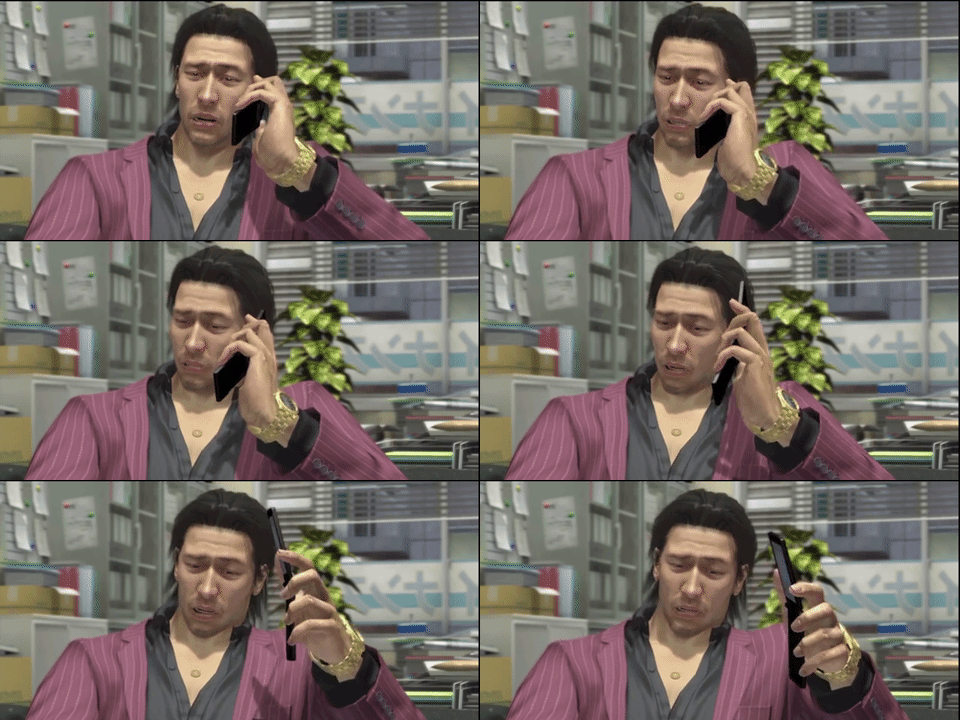
With Kiryu’s story told, a new main character is stepping in to take his place, and there’s a lot of new and interesting directions that the constant strife and struggles of the yakuza clans could take. I’ve been following the development and features of 7 with some interest, and it’s proving a pretty radical departure in a number of ways. They’re actually making it a turn-based JRPG, crazily enough!
There was quite a bit of fan outcry at that, as you’d expect, but I remained fairly resolute that RGG Studios have earned the chance to try something new and I would happily indulge them, whatever it takes. I might miss the brawling action, but everything else that stands out about the series seems to be present and correct, and it honestly looks fantastic as ever. I truly cannot wait to get my hands on it.
And so… that’s where we are. I’ve gone from barely knowing what the Yakuza series was to being a devout fan, eager to get my hands on every new game and see where it takes me. In this day and age, it usually takes a brand new series to really catch me off guard given how well connected I aim to be with video games as a whole. The fact that Yakuza was able to blindside me half a dozen games in is a genuine shock, and not likely to ever be repeated again. I truly relished the experience, and I will be here to see where it goes from this point forward.
If you haven’t given Yakuza a try, and you’ve managed to read this far in this massive wall of ranting text, I heartily urge you to follow my footsteps and pick up Yakuza 0. It’s on Steam or PS4 for cheap, and it’s so worth your time. Bear with it through any slow start and let it immerse you, and I absolutely believe you’ll be able to get out more than what you put in.
One last point, then: since I’ve talked about the entire mainline series and hinted at how I’ve ranked them, here’s that list in full for those curious:
0 > Kiwami 2 > Judgment > 6’s Ending > 4 > The rest of 6 > Kiwami 1 > 3 > 5
No doubt plenty of people have different feelings on where they all line up and why, but that’s how I see them, and I’d love to talk about where you found yourself. So yeah… play Yakuza, and let’s talk about it, shall we?
Denouement
Right! So this has been long overdue. I’d wanted to talk about Yakuza 0 more in depth ever since I played it, and last year’s list of games I liked was probably the closest I’d come to it that far. I could honestly have written an article on each game if I really wanted, and that’s still not out of the question.
But this article was largely just intending to be a quick overview of my experience with the series before it descending into detailed gushing. I kept telling myself that after finishing up what I said about 0, I’d make shorter points about the rest and get through the whole thing in short order. Alas, that’s not how things played out, and I ended up talking far more about each than I’d intended. Cest la vie.
As such, I think this is the longest blog post I’ve ever written here. It took many more writing attempts and thousands more words than I expected to write on it, so if you’ve gotten this far, I genuinely thank you for your time and attention thus far. I did my best to spruce it up with images and clips just to keep it from being too dry, but hey… really, I just wanted to talk about Yakuza. It has long been deserving of this kind of larger write-up and inspection.
Hopefully this piece was able to adequately convey just how much I came to love these games, and why. If even one person walks away from this convinced to check out the Yakuza games more closely as a result, I will consider this entire undertaking absolutely successful and worthwhile. But regardless, I can’t stress enough how thankful I am for you reading this, and hope you enjoyed it.
Last point to make is that yes, I’m actively writing again. There probably would have been another article or two in here by now if I hadn’t spent so long dedicated myself to this one, so stay tuned and they’ll probably start appearing soon. But I also have more exciting news on that front, as after a long time of general inactivity and disinterest… I have gotten a new writing gig on website DualShockers! It’s far more established a platform than I’m used to, and I’m thrilled at the opportunity. Given the holiday period, I’m still being trained quite slowly, but I’ve already put up one article serving as this year’s Delfies Top 10. I’ll cross link those articles here whenever I write something for the blog. Supporting that website and I would be immensely appreciated, so I’ll keep you posted.
As for what I write here, well, not everything I choose to write will be ideal for DualShockers due to timing or general conversational tone… so that’s probably what will be found here. Maybe this is the perfect opportunity to resurrect the Battle Reports? We’ll see.
Anyway, you’ve been here for long enough, I’m sure. Thanks again, and see you next time.
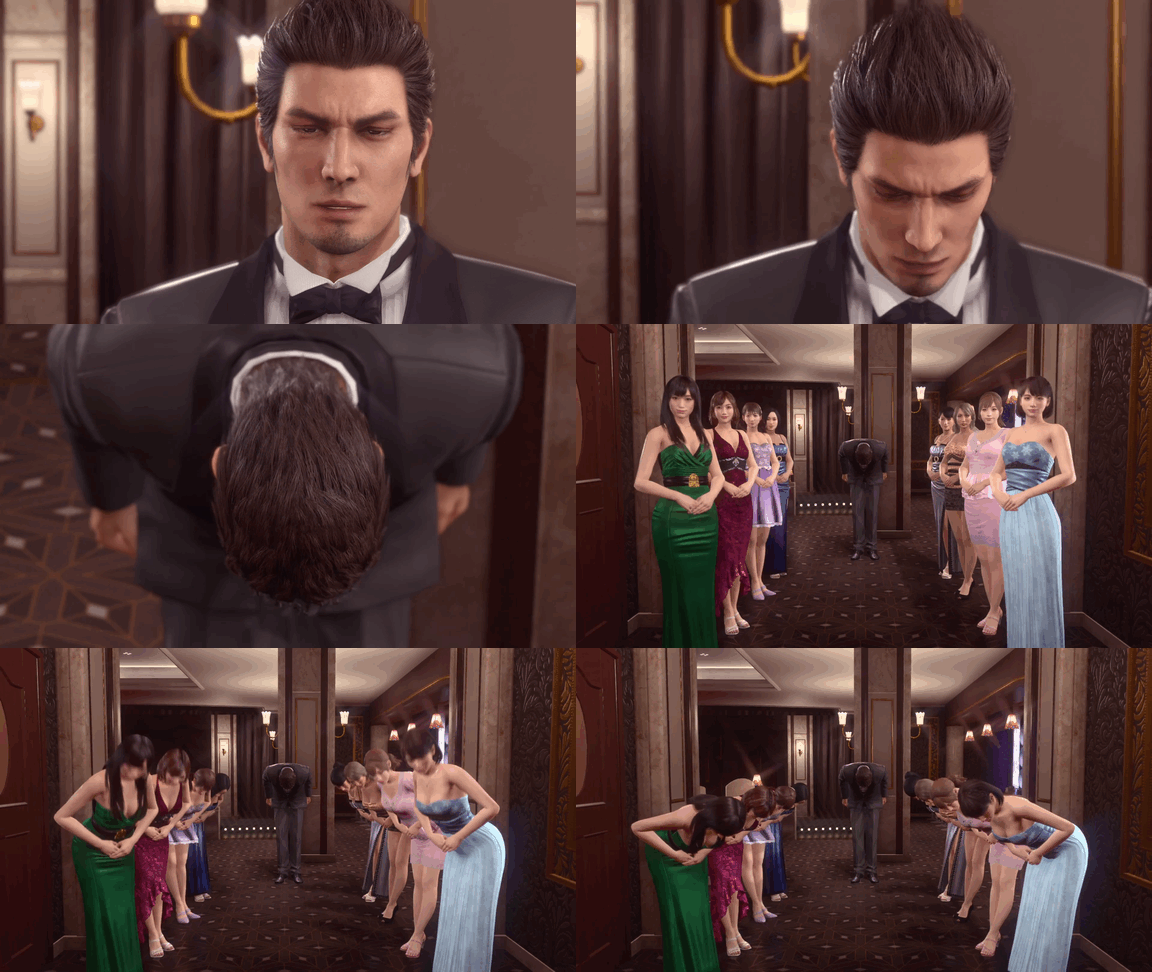
PS: Play Yakuza~

 Delfeir vs. the Backlog
nerd
LikeLiked by 1 person