Hello. I’m Delfeir, and on Friday I played a new game. My intention was to sample it for about an hour before writing something unrelated. I did no writing, played for about four hours, delayed my sleep so I could play yet another, and then had dreams about the damn thing. Once I woke up and told people about it somewhat, I intended to write this impressions piece that you’re now reading. Instead, I played more of the game in question for the better part of the whole weekend. I’ve almost completely finished it with 30 hours under my belt in that time. Even now, however, the siren song to finish the tail of the game still calls.
Loop Hero might be the most addictive game I have ever played, ye gods. So let’s talk about it.
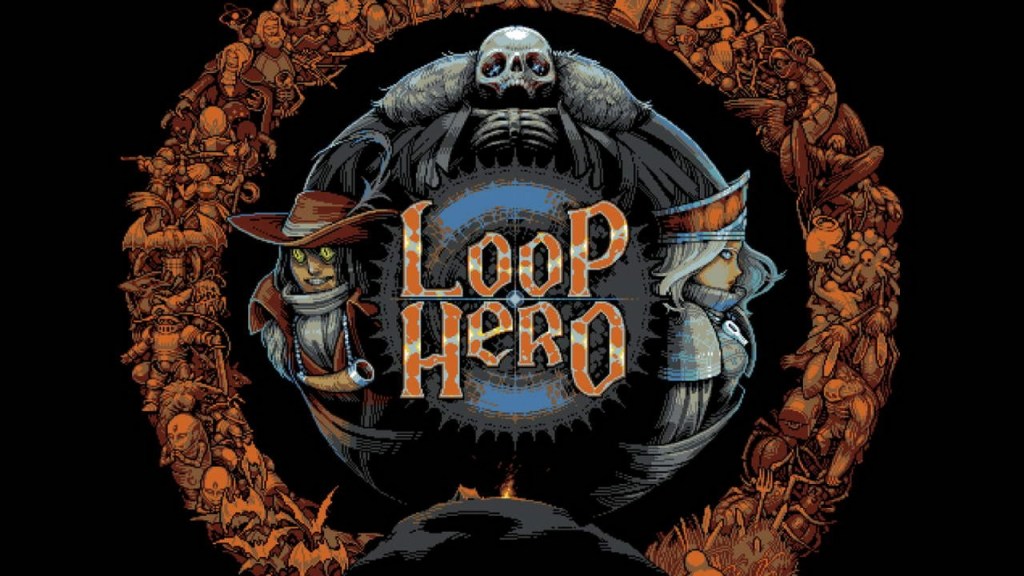
Loop Hero is a weird blend of genres right out the gate. The best way to describe it would honestly be to call it an idle game, the genre that Cookie Clicker birthed. It also takes cues from auto battlers like the Dota Auto Chess mod. Wrap that framework with a roguelite deck building game and resource gathering, and you have the bones of Loop Hero.
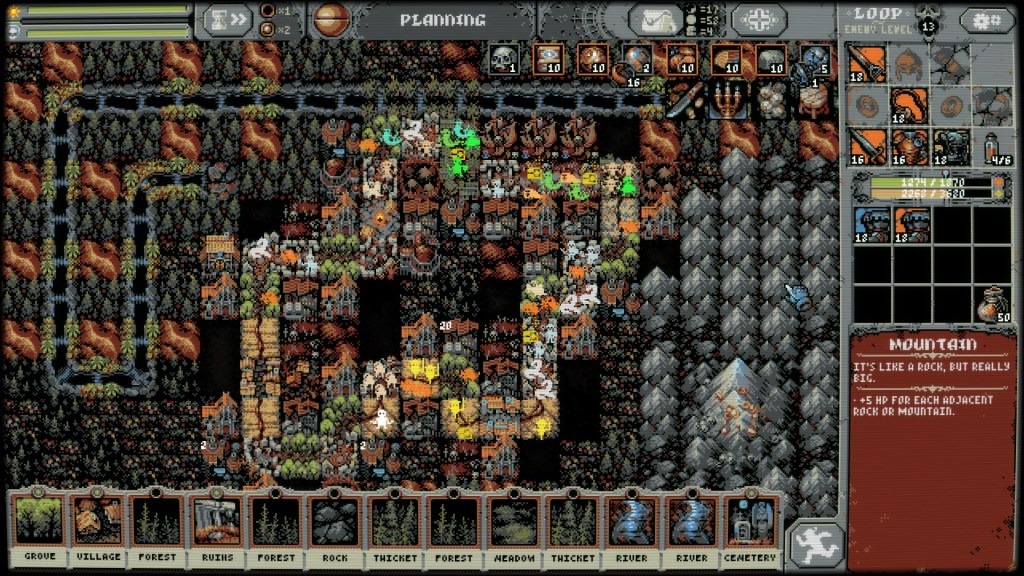
Here’s how it works: you’re a hero placed on a randomly generated path that loops into a campfire. The character automatically walks along this path, fighting any encounters in their path. When you do a fall lap, you’ve completed a loop, which raises the enemy level. Rinse and repeat until you end the run through tactical retreat or untimely death. Aside from pausing or equipping new equipment you find, that’s the only direct control you’ll have over the hero.
Instead, you directly interact with the world through the cards that drop. Depending on the card type, these can be placed in tiles adjacent to the road, further into the “void”, or on the road tiles itself. The hero will automatically interact with them as they pass or step on, gaining resources or performing interactions with them. Many of the tiles will also spawn enemies, however. Even the empty roads can spit out basic slime enemies, so there’s always something to wail on and get your first card draws.
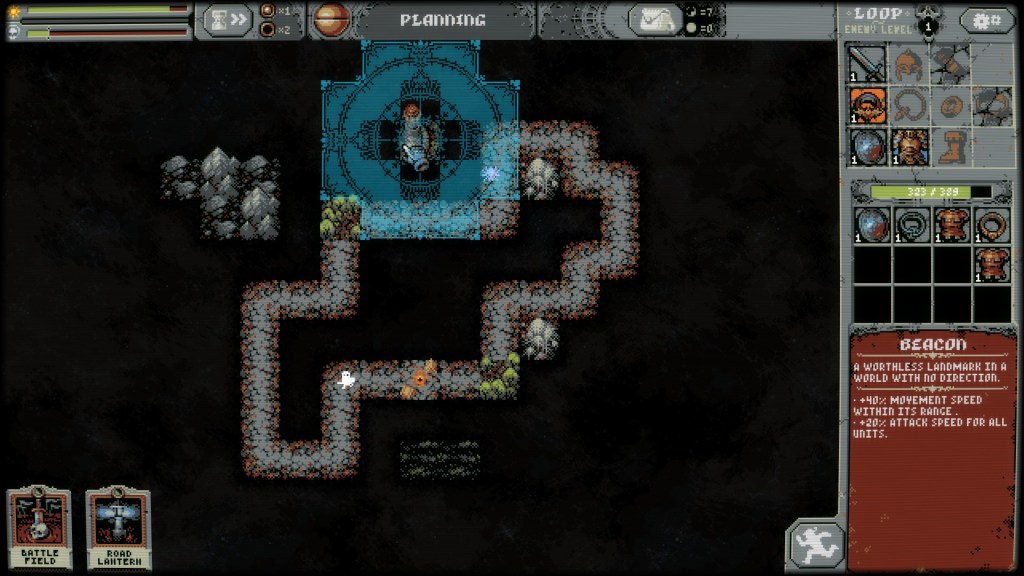
And this is the crux of Loop Hero. The cards you get let you build the obstacles your hero faces on the fly. Success is determined both by which available cards you select prior to a run, and how you arrange those cards on the field. Add in the inevitable RNG, boost it with bonuses that you build in your camp between runs, and that’s your gameplay… *ahem* loop. As time passes in the run, a bar will fill to signify an in-game day, and new obstacles will spawn from the appropriate tiles at certain thresholds. The loops will keep going as long as you can maintain it before fleeing.
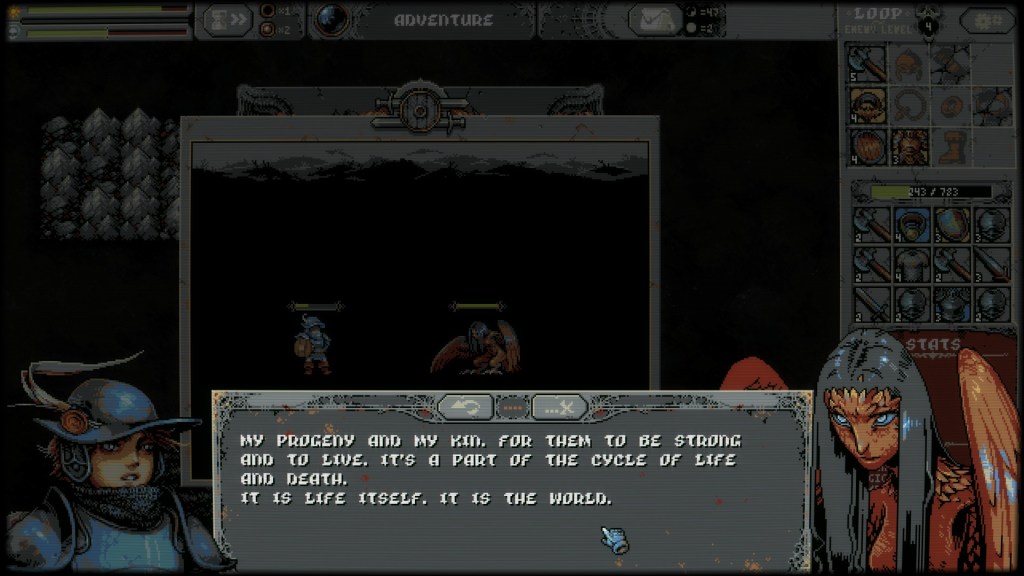
On its own, this would probably just be a curiosity rather than quite so compelling a game. But where Loop Hero shines is the way specific card combinations can interact and change your board. Rocks and Mountain cards will increase your max HP for each other rock and mountain adjacent. Naturally, this will lead to you maximising your gains by arranging stone in a 3×3 formation. Well, when you do, that formation instantly changes into a Mountain Peak, which gives a higher HP bonus than the individual tiles normally would. However, it also will spawn a Harpy somewhere on the loop every couple of days.
There’s a lot of interactions like this, and figuring out what cards interact with what is key to triggering certain encounters. And it’s important to do so, because Loop Hero has roguelite progression that fuels its addictive nature. Certain enemy types or tiles will produce specific resource shards. Once you collect a certain number of shards, they coalesce into a whole resource, and you can expend those in between runs to upgrade your camp. New buildings you produce or upgrade will unlock new card types for your deck, provide passive bonuses, or unlock new classes that play very differently. And getting the more advanced and rare resources requires careful combinations to create.
I’m particularly susceptible to the Number Go Up mentality that idle games provide, so I’m a complete sucker for this progression. But where most idle games lack any real thought and just sit in the background to provide gratification, Loop Hero requires that little bit more engagement. You won’t make much headway without equipping the item drops, tailoring your gear and stats to what you’re facing on the fly, and building a loop that accomplishes what you need it to.
And there is an endpoint to reach, complete with bosses! You really need to have a good setup to survive the bosses, particularly in the last chapter. Some runs will be spent trying to farm specific resources, while others are attempts at making it to the end. Each chapter increases the rate at which enemies get faster per loop, as well as lengthens the survival time required before the boss will spawn. Just making it to them in the later chapters can be intimidating, let alone successfully beating them.
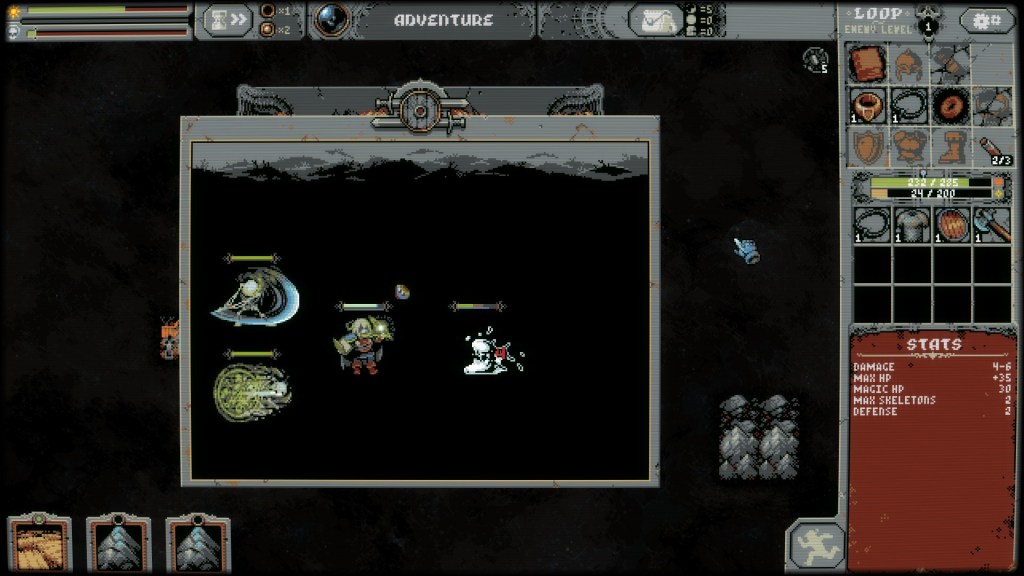
Perhaps the only reason that my obsession with Loop Hero has slowed at all is because I’m basically at the end. I’ve discovered nearly every combination, built every unique building, and have access to just about anything. All I need to do now is get a good run to clear the final chapter’s boss. Much as I want to do that, it’s reached the point of being a more tedious than entertaining grind to do so. It’s the kind of thing I’ll throw on a movie or podcast and just focus on that while chipping away in the background.
Loop Hero thrived on the sense of discovery. Trying to figure out how to unlock specific cards or discerning what combined with what was the meat of the gameplay, and I couldn’t get enough of it. Sadly, there’s always a limit to this. Once I got all but the most tenacious unlocks, the thrill of discovery gave way to rote repetition. While there’s still engagement to be had, the fact that Loop Hero is actually still a game rather than an endless number treadmill ala Cookie Clicker. It’s less concerned about endlessly feeding my lizard brain. Frankly, that’s commendable, and turning such a passive genre into something so much more engaging is impressive.
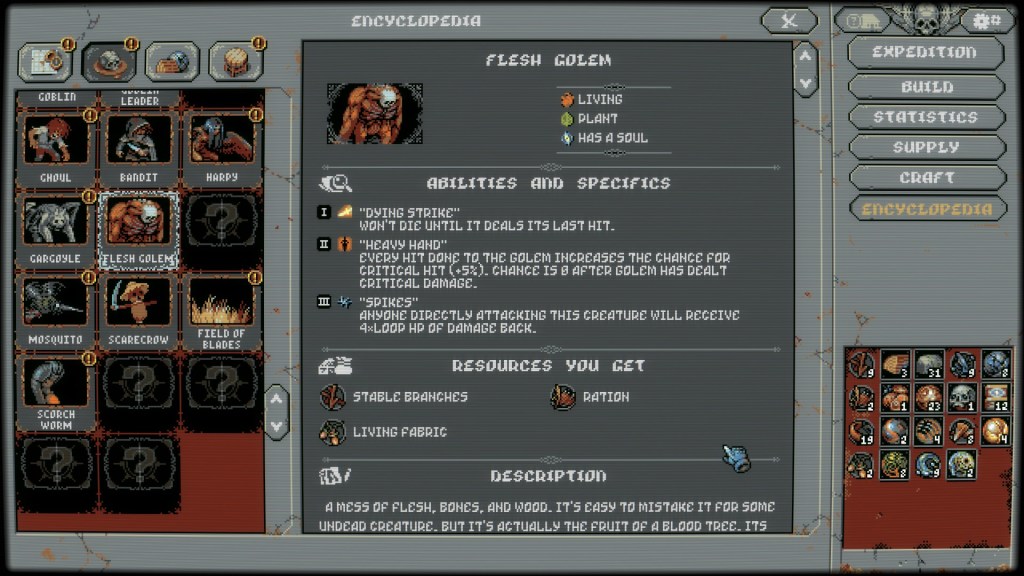
What’s also impressive is the attention to detail on the presentation. Loop Hero is almost aggressively retro, featuring gorgeous pixel art in a nonetheless limited colour palette. It even has faux scanlines! The music is catchy chiptune tracks and there’s a ton of distinct audio cues for the cards and effects. It’s an extremely authentic, all-in take on retro design, but with game design and concepts of the modern day.
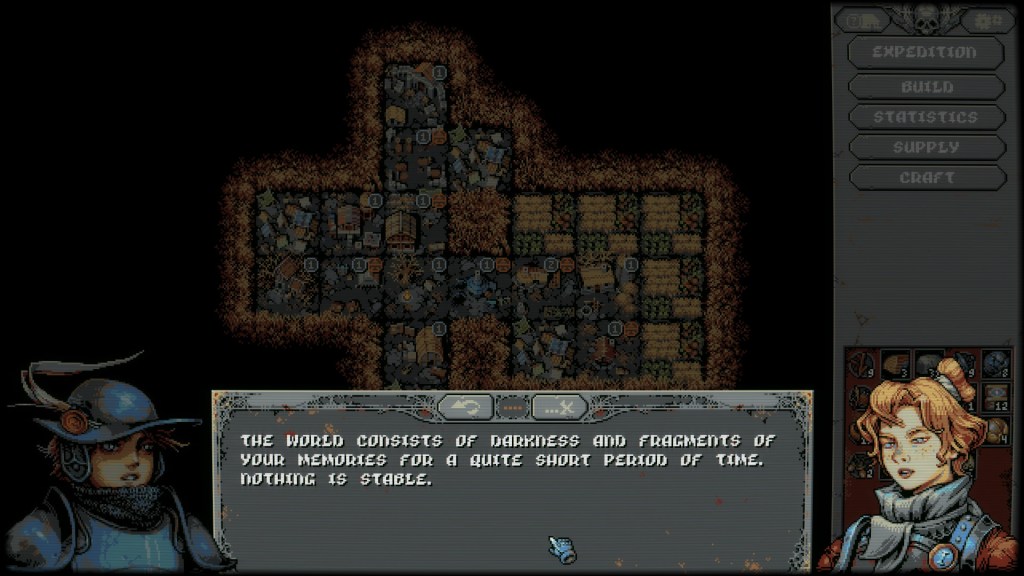
This goes all the way up to a story that’s actually not too bad! It’s largely lore and flavour that justifies the various mechanics and why you’re looping through an endless void, but it’s a remarkably interesting concept. The entire thing is basically a depiction of memory of a world before this all-consuming apocalypse. Somehow, the hero has survived, and the world rebuilds itself around them according to the memories that they’re able to reproduce. I’m not doing it justice, but suffice to say that it’s an immaculately dressed window.
It’s safe to say that I recommend Loop Hero. It’s pretty cheap on Steam (20 bucks AUD, slightly discounted at time of writing) and is sitting on overwhelmingly positive. There’s even a free demo, which was more or less the player’s choice of the most recent Steam Game Festival. My buddy Ricky was raving about the game as far back as last year after doing previews for it, and it’s fair to say that he was correct.
So yeah. If this sounds interesting, then check it out. Or, y’know, don’t. Because Loop Hero is a horrible time vampire that relentlessly consumed my weekend. Seriously, I had the beginnings of a draft for this piece a couple of days ago, but writing about it just made me go play it more. But aside from that, it comes highly recommended! And if you’re in the business of supporting indie devs, this is the same team (Four Quarters) that previously made Please Don’t Touch Anything, which was a delightful puzzle game in its own right. So chalk this up as another win for Devolver Digital; may they continue to get solid indie games published and avoid all the pitfalls that turn you into a triple-A publisher.
We don’t need more of that, we need more stuff like Loop Hero.
Next time I’m writing about Bravely Default, for real. Very close to the end of Bravely Default 2, and if I don’t have something about that to cover, then I’m going to do a retrospective on the first game instead. Or maybe both. Because I can. Until next time.

 Delfeir vs. the Backlog
2 thoughts on “Loop Hero Impressions — Brother, May I Have the Loops”